Meet Recent BURN@N3AS Students
Hong Joo Ryoo, Former student;
John Hopkins graduate student, working with Sean Carroll
Received the prestigious NSF GRFP Graduate Fellowship for his PhD research proposal on the role of the three-body system in quantum computations of scattering observables.
Publication by Hong Joo Ryoo: GRACE: an Agentic AI for Particle Physics Experiment Design and Simulation →
We present GRACE, a simulation-native agent for autonomous experimental design in high-energy and nuclear physics. Given multimodal input in the form of a natural-language prompt or a published experimental paper, the agent extracts a structured representation of the experiment, constructs a runnable toy simulation, and autonomously explores design modifications using first-principles Monte Carlo methods. Unlike agentic systems focused on operational control or execution of predefined procedures, GRACE addresses the upstream problem of experimental design: proposing non-obvious modifications to detector geometry, materials, and configurations that improve physics performance under physical and practical constraints.

Hong Joo Ryoo
Alex Wang, Former N3AS student;
University of Hong Kong, Physics Doctoral Program
Publication accepted by Physical Review D:
by Shengzhu Wang, Antón Baleato Lizancos, and José Luis Bernal:
Delensing CMB 𝐵 -modes using galaxy surveys: The effect of galaxy bias and matter clustering nonlinearities →
The 𝐵-mode of polarization of the CMB is a uniquely powerful probe of gravitational waves produced in the very early Universe, but searches for primordial 𝐵-mode anisotropies must contend with gravitational lensing, which induces late-time 𝐵-modes not associated with gravitational waves.

Nathan Olson, Former N3ASstudent
Honors thesis supervised by Prof. White:
Forecasting Constraints on Primordial Non-Gaussianity: A Tomographic Study with SPHEREx →
The measurement of primordial non-Gaussianity (PNG) is one of the key targets for upcoming cosmological surveys as detecting it would provide invaluable information about the physics of the early universe. read more
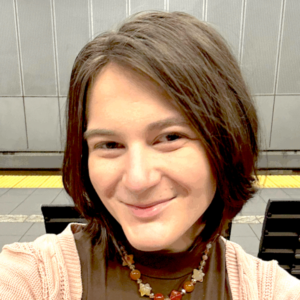
Catherine Welch, formerINT UW/N3AS student,
Graduate student, Physics, UC Berkeley
Publication on arXiv.org
by Mia Kumamoto and Catherine Welch:
Effects of Landau quantization on neutrino emission and absorption →
Some neutron stars known as magnetars possess very strong magnetic fields, with surface fields as large as  and internal fields that are possibly stronger. Recent observations of the radio pulsar GLEAM-X J1627 suggest it may have a surface field as strong as
 . In the presence of a strong magnetic field, the energy levels of electrons and protons are quantized and the Direct Urca process allows neutron stars to cool rapidly, even at low density. For the case of magnetic fields
 , we find features in the emissivity due to energy quantization that are not captured by the frequently employed quasiclassical approximation… read more
Brandon Lem, Former student;
Michigan State University, Physics Doctoral Program
Publication accepted by Physical Review D:
by Daniel J. Heimsoth , Brandon Lem, Anna M. Suliga, Calvin W. Johnson, A. Baha Balantekin et. al.:
Uncertainties on the EFT coupling limits for direct dark matter detection experiments stemming from uncertainties of target properties →
Direct detection experiments are still one of the most promising ways to unravel the nature of dark matter. To fully understand how well these experiments constrain the dark matter interactions with the Standard Model particles, all the uncertainties affecting the calculations must be known. It is especially critical now because direct detection experiments recently moved from placing limits only on the two elementary spin independent and spin dependent operators to the complete set of possible operators coupling dark matter and nuclei in nonrelativistic theory. In our work, we estimate the effect of nuclear configuration-interaction uncertainties on the exclusion bounds for one of the existing xenon-based experiments for all fifteen operators. We find that for operator number 13 the uncertainty on the coupling between the dark matter and nucleon can reach more than 50% for dark matter masses between 10 and 1000 GeV.


Santiago Rodriguez, Former student;
Staff Technician, Advanced Light Source, LBNL
Publication on arXiv.org
by Lucas Johns and Santiago Rodriguez:
Collisional flavor pendula and neutrino quantum thermodynamics →
Neutrino flavor oscillation occurs because neutrinos emitted in a certain flavor are composed of a superposition of different neutrino mass states. In a dense enough environment, neutrino self-interactions synchronize flavor on large scales. In the two-flavor approximation, the resulting dynamics show similar behavior to the classical spinning top and inverted pendulum under some conditions. We explore the neutrino flavor pendulum with the addition of charged-current interactions and absorption/emission processes. In addition, investigating their effects in densities and time scales relevant to the isotropic and monochromatic emission of neutrinos from core-collapse supernovae, similar to neutrino the bulb model. We are able to identify the synchronized and bipolar modes of oscillation and constrain the polarization pendulum to a sphere and a circle in flavor space.
In 2023, Santiago has presented this research at the American Physical Society Far West Section, in San Diego.
Danial Baradaran, Former student
Publication accepted by Physical Review D
by Danial Baradaran, Boryana Hadzhiyska, Martin J. White, and Noah Sailer:
Predicting the 21 cm field with a Hybrid Effective Field Theory approach →
A detection of the 21 cm signal can provide a unique window of opportunity for uncovering complex astrophysical phenomena at the epoch of reionization and placing constraints on cosmology at high redshifts, which are usually elusive to large-scale structure surveys. In this work, we provide a theoretical model based on a quadratic bias expansion capable of recovering the 21 cm power spectrum with high accuracy sufficient for upcoming ground-based radio interferometer experiments. In particular, we develop a hybrid effective field theory (HEFT) model in redshift space that leverages the accuracy of N-body simulations with the predictive power of analytical bias expansion models, and test it against the Thesan suite of radiative transfer hydrodynamical simulations… read more
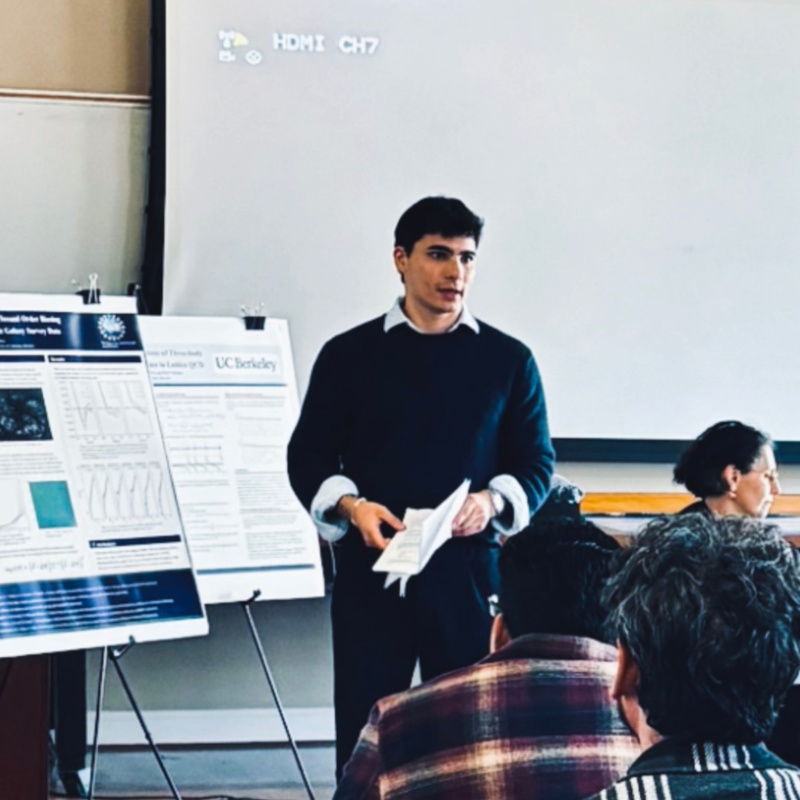
Danial Baradaran
Malika Golshan, Former student;
Test Engineer, Cmatrics
Publication on arXiv.org
by Malika Golshian and Adrian Bayer:
Massive νs through the CNN lens: interpreting the field-level neutrino mass information in weak lensing →
Neutrinos, once thought to be massless according to the standard model, have proven otherwise due to the fascinating observation of neutrino flavor oscillations. In our research project, we take a unique approach by harnessing the power of machine learning to address a crucial question: Can computers aid in distinguishing between mass-bearing and massless neutrinos? By leveraging Convolutional Neural Networks (CNNs) on simulated weak lensing maps, our goal is to achieve a more accurate measurement of neutrino mass using cosmological methods.
I am deeply grateful to both my mentors. Vanessa, my initial mentor, provided me with a solid foundation and inspiration for this project. Adrian then became my mentor while transitioning to his postdoctoral position at Princeton. His unwavering dedication and expertise guided me through the intricacies of data analysis.

Malika Golshan

Henry Purcell
Henry Purcell, Former student;
Intern, NASA Ames Research Center
Publication accepted by Physical Review D (May 2024)
by Henry Purcell, Sherwood Richers, Amol V. Patwardhan, Francois Foucart:
Three-flavor, Full Momentum Space Neutrino Spin Oscillations in Neutron Star Mergers →
In the presence of anisotropic neutrino and antineutrino fluxes, the quantum kinetic equations drive coherent oscillations in neutrino helicity, frequently referred to as spin oscillations. These oscillations depend directly on the absolute mass scale and Majorana phase, but are usually too transient to produce important effects. In this paper we present a full momentum-space analysis of Majorana neutrino spin oscillations in a snapshot of a three-dimensional neutron star merger simulation. We find an interesting angular dependence that allows for that resonant and adiabatic oscillations to occur along specific directions in a large volume of the merger remnant… read more
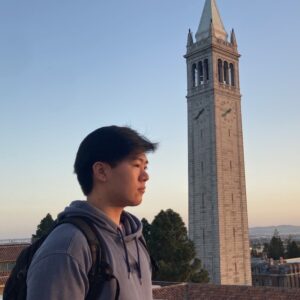
Daniel Xing
Daniel Xing, Former student;
Graduated 2023, currently training in Los Alamos, working with the DUNE team
Discovering the origin of neutrino’s mass and their oscillation parameters could answer the matter antimatter asymmetry in our universe, and allow us to better understand astrophysics phenomena. Currently, multiple flagship experiments exploring neutrinos are underway, and to have full confidence in their results, accurate and precise neutrino nucleus cross sections are required. My project is to analyze data from lattice QCD calculations to determine one of these cross sections.